

Sakana Fugu is the strangest major AI release of 2026, and the most interesting. Ask most AI models a question and one neural network produces the answer. Ask Fugu, and you may be getting a small, temporary team: an orchestrator that reads your task, decides which frontier models to involve, assigns them roles, coordinates their work, and hands you back a single response — all behind one ordinary API call.
Sakana AI describes Fugu as “a multi-agent system delivered as one model,” and sells it with the tagline “One Model to Command Them All.” This guide explains what that actually means in practice: how the orchestration works, what the three Fugu models are for, what it costs, and where you can (and can’t) use it. Everything here traces to Sakana’s official documentation, and volatile facts are date-stamped.
What Sakana Fugu is — and what it isn’t
Start with what it isn’t, because the category is genuinely new and the wrong mental model will mislead you in expensive ways.
Fugu is not another frontier model trained from scratch to compete with ChatGPT, Claude, or Gemini on raw single-model capability. Sakana didn’t spend its compute budget growing yet another giant network; it spent it teaching a system to command the giants that already exist.
It’s not a static router either. Router products pick one model per request — cheap model for easy questions, expensive model for hard ones — and forward your prompt untouched. Fugu can do that when one agent suffices, but its defining behavior is assembling several models into a working team, with structure and communication between them.
And it’s not an agent framework. With orchestration libraries, you design the workflow: you decide there will be a planner, a coder, and a reviewer, write their prompts, and wire the loop. Fugu inverts that. The thing Sakana trained is the coordinator itself — a model that learned how to assemble agents, split up work, and combine results across a pool of powerful third-party models. Which models it consults, how many agents it spins up, and how they talk to each other are decisions it makes per task, not choices you configure.
From your side, none of this machinery is visible in the interface. You call one API — OpenAI-compatible, so existing code mostly just works — and you get one answer, with a usage report describing what the system consumed. Two consequences follow, and they shape everything else on this site.
First, the positioning. Sakana pitches Fugu as frontier-level performance without single-vendor dependency — you’re not betting your stack on one provider’s roadmap, outages, or pricing decisions — and, in its words, “without the risk of export controls.” Each API key even has a custom model pool setting that lets you exclude specific underlying providers for privacy or compliance reasons: if your organization can’t send data to a particular vendor, you switch that vendor off for your key and Fugu routes around it.
Second, the billing. The orchestrator’s internal work consumes tokens, and those orchestration tokens are real, billed usage, not free metadata. If you evaluate Fugu on a per-token price table alone, you will underestimate your bill. We built a cost calculator specifically to model this.
Who is Sakana AI?
Sakana AI is a research company based in Tokyo, Japan, founded in 2023. Its co-founders include Llion Jones — a co-author of “Attention Is All You Need,” the paper that introduced the Transformer architecture behind essentially every modern language model — and David Ha, known for research on nature-inspired and evolutionary methods.
That nature-inspired lens explains both the company’s research style and its naming. Sakana is Japanese for “fish,” and the products follow the theme: Fugu is a pufferfish, and Sakana Namazu — the company’s separate Japanese-specialized model — is a catfish. The fish motif is more than branding. Sakana’s research bets on collective behavior: the way schools of fish produce intelligence no single fish has. Fugu, a system whose capability emerges from coordinating many models, is that idea shipped as a product.
The timeline so far: Fugu launched in June 2026 alongside a technical report, with the earlier Ultra build date-stamped mid-June. In early August 2026, Sakana opened the API for Namazu, its Japanese-specialized model. And on August 13, 2026, Fugu reached consumers for the first time when Sakana Chat added it for logged-in users. It has been a fast first summer.
How the orchestration actually works
Fugu’s product architecture grows out of two Sakana research papers, both accepted at ICLR 2026. You don’t need to read either to use Fugu, but knowing the ideas makes the system’s behavior — and its billing — much less mysterious.
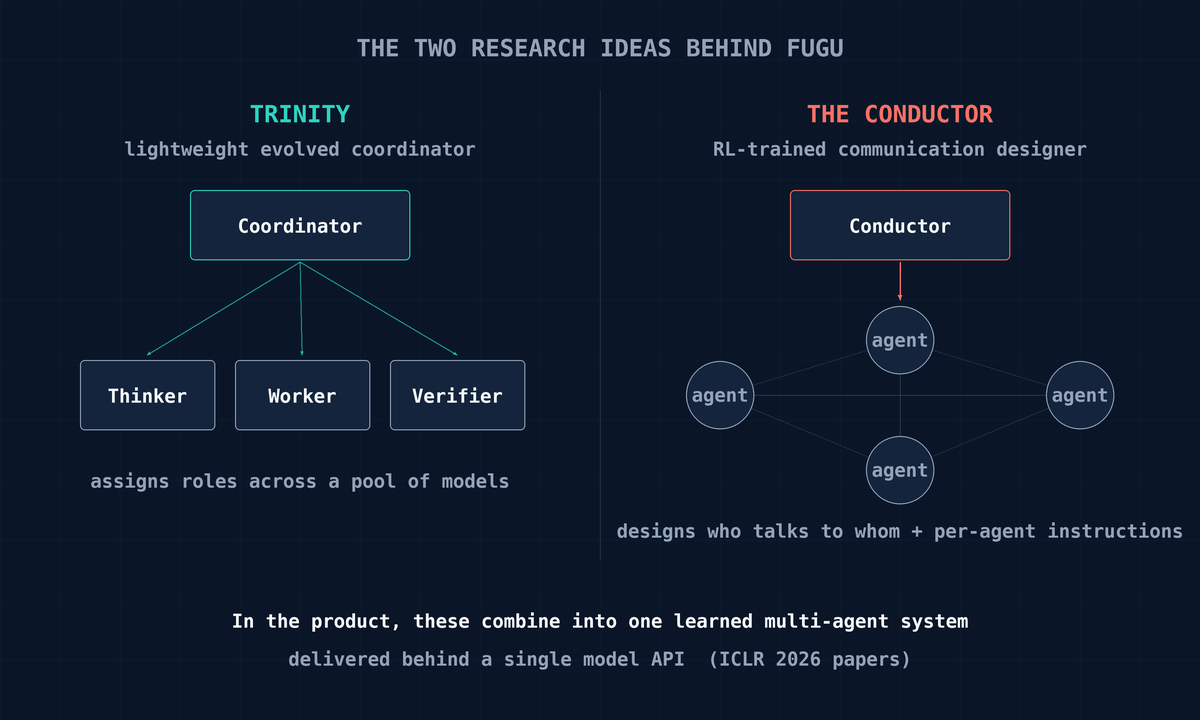
TRINITY: an evolved coordinator with three roles
The first paper, TRINITY, describes a lightweight coordinator — developed with evolutionary methods rather than brute-force training — that sits in front of a pool of language models and assigns them roles: a Thinker to reason about the problem, a Worker to produce the actual output, and a Verifier to check it. The coordinator itself stays small and cheap; the heavyweight intelligence lives in the pool.
The insight is that a well-orchestrated team of existing models can outperform any single member — including on tasks where the best individual model already looks strong. Division of labor helps machines for the same reason it helps people: the skills that make a great first-draft writer aren’t the skills that make a great editor.
The Conductor: learned communication design
The second paper, the Conductor, tackles the part humans usually hard-code: who talks to whom. The Conductor is a model trained with reinforcement learning to design agent-to-agent communication topologies and to write targeted instructions for each worker — deciding, per problem, whether agents should work in a chain, debate each other, or fan out in parallel, and telling each one exactly what its job is.
That last part is easy to underestimate. In hand-built multi-agent systems, every agent typically sees the same task description and much of the same context, which wastes tokens and blurs responsibility. A trained conductor writing per-agent briefs — this is your sub-problem, here is exactly what you need to know — is both a quality mechanism and a cost mechanism.
What happens to your request, step by step
- Your prompt arrives through the standard API, exactly as it would at any other provider.
- The orchestrator reads the task and decides the team: possibly a single model for a straightforward request; for Fugu Ultra, between one and three expert agents for a hard one.
- It designs the collaboration — roles, communication pattern, and a targeted brief for each agent.
- The agents work; the orchestrator coordinates, checks, and synthesizes one final response.
- You receive that response plus a usage object itemizing everything consumed — including the internal orchestration tokens, which are billed at standard rates.
Every step of that internal conversation consumes tokens — which is why Fugu’s pricing deserves more attention than a typical model’s.
The model family: Fugu, Fugu Ultra, Fugu Cyber
Fugu is the default, built to balance performance against latency. It routes each task to the best model in the supported pool, and its billing follows the routing: you pay the standard rate of the underlying model used — and when several are involved, fees are never stacked; you pay a single rate based on the top-tier model in the mix. For most day-to-day coding and reasoning work, this is the model Sakana intends you to use.
Fugu Ultra is the deep end. It draws on a larger pool of expert agents and routes between one and three agents per problem, targeting hard, high-stakes tasks where extra compute buys real quality — the kind of problem you’d otherwise hand to your most senior engineer and a reviewer. Unlike base Fugu, Ultra has fixed per-token rates ($5 in / $30 out per million tokens as of August 2026, with a higher tier above 272K context — full details in the pricing guide).
Fugu Cyber is a specialized variant for cybersecurity reasoning — security analysis, vulnerability research, threat investigation. It is deliberately harder to get: access requires a request form describing your use case plus a manual review, billing is pay-as-you-go only, and pricing goes through Sakana’s sales team. The gating reflects the dual-use nature of security tooling, and it means Cyber is a considered procurement rather than an impulse toggle.
Alongside the family sits Sakana Namazu — not a Fugu variant but a separate, Japanese-specialized model with built-in tools (web search, code execution), image and file input, and extended thinking. It matters to Fugu users for two practical reasons: it’s the anonymous default on Sakana’s chat site (a common source of confusion), and at $0.95 per million input tokens it’s a cheap way to test Sakana API plumbing before pointing real workloads at Ultra.
Specs worth knowing across the family: the context window is 1,000,000 tokens, with a separate long-context pricing tier once a request’s context exceeds 272K tokens, and the API exposes reasoning-effort levels (high, xhigh, and a maximum level) that trade cost for thoroughness.
What people use Fugu for
Sakana’s own published use cases cluster in three areas.
Coding is the flagship. Fugu ships with official one-line integrations for the Codex and Claude Code coding agents — see our Codex and Claude Code guides — and Sakana’s June 2026 evaluation leads with software-engineering results. The fit is natural: real engineering tasks decompose into exactly the plan-implement-verify pattern the orchestration was trained on.
Research-grade reasoning is the showcase. Sakana reports Fugu Ultra being used in competitions, for reproducing results from research papers, and for patent and literature review — long, multi-step problems where a Thinker/Verifier loop earns its cost, and where a wrong answer is expensive enough that paying for verification makes sense.
Review and verification round it out. Having one model check another’s work is the whole point of the architecture, so tasks that are fundamentally about checking — code review, claim verification, quality assurance on generated content — play to Fugu’s structure rather than fighting it.
On benchmarks: Sakana’s June 2026 evaluation reports, among other results, Fugu Ultra at 73.7 on SWE Bench Pro (base Fugu: 59.0), 82.1 on TerminalBench 2.1 (80.2), 93.2 on LiveCodeBench (92.9), and 95.5 on GPQA-Diamond — where base Fugu matches Ultra exactly — with baselines drawn from leading frontier models. Interestingly, Sakana’s own table shows base Fugu ahead of Ultra on a few tests, including SciCode and long-context reasoning, a useful reminder that more agents isn’t automatically better. As always with vendor-reported numbers, treat them as the maker’s own measurement; the full comparison table is on Sakana’s site.
How to access Fugu
There are four working routes as of August 2026:
- The Sakana API. Create a key in the console at console.sakana.ai and call an OpenAI-compatible API (there’s an Anthropic-compatible endpoint too). Billing is pay-as-you-go via prepaid credits, or a subscription — the $20/$100/$200 tiers all include both Fugu and Fugu Ultra.
- Third-party platforms. Sakana lists OpenRouter, Vercel, opencode, Creao, and Merge as distribution partners, each under its own terms and billing. Our browser playground runs on OpenRouter with your own key and shows you cost per message.
- Coding agents. An official installer (
curl -fsSL https://sakana.ai/fugu/install | bash) wires Fugu into Codex, Claude Code, or both, on Ubuntu and macOS (Windows needs manual setup). Step-by-step guides: Claude Code, Codex, Windows. - Sakana Chat. Since August 13, 2026, Sakana’s consumer chat at chat.sakana.ai offers Fugu to logged-in users; anonymous visitors get Sakana Namazu instead. We cover the details — and what’s still unpublished about that access — in Can you chat with Fugu online?
Which door is right depends on what you’re doing: casual curiosity points to Sakana Chat, evaluation points to the playground (same API path you’d ship with, cost telemetry included), daily coding points to a subscription plus the agent integrations, and production points to pay-as-you-go API keys.
Availability and restrictions
Two restrictions are load-bearing. First, region: Sakana’s supported regions exclude the EU/EEA, the UK, and Switzerland. The company’s landing page states Fugu is “not yet available in the EU/EEA while we work toward compliance with GDPR,” and access may be enforced through IP controls. Fugu is distributed through third-party platforms under their own terms, but nothing about that changes the official availability position — if you’re in a restricted region, the supported answer is to wait.
Second, age: Sakana’s terms restrict use to adults 18 and over.
Beyond those, a few policy facts are worth knowing before you send anything sensitive. Sakana’s terms state that API inputs and outputs are used for training by default — an opt-out exists, so flip it if your data matters. Entering personal information is prohibited outright. Sharing credentials is prohibited, and all usage on a key is attributed to the key’s owner, so treat keys like passwords. And building competing services on the API is against the terms.
A note on the code: Fugu’s installer tooling lives in a public GitHub repository, but the repository carries no license, and Fugu itself is a hosted commercial service — the models are not something you download or self-host.
Key terms, quickly
Orchestrator — the model Sakana actually trained: it reads your task, assembles the team, coordinates the work, and synthesizes the answer. Agent — one working instance of an underlying model, given a role and a brief for the duration of your request. Model pool — the set of frontier models the orchestrator can draw on; per API key, you can exclude providers from it. Orchestration tokens — tokens the internal machinery consumes beyond your visible prompt and response; on Fugu Ultra and Fugu Cyber they are billed at standard rates and reported in every response’s usage object. Reasoning effort — the high/xhigh/max dial controlling how much internal work a request gets; more effort, more quality, more tokens. Long-context tier — the pricing band above 272K tokens of context, where Fugu Ultra’s rates roughly double.
One term to be careful with: “router.” You’ll see Fugu described that way in passing commentary, and it undersells the system. Routing — picking a model — is the trivial case of what the orchestrator does; the trained behavior is team assembly, communication design, and verification. The billing model only makes sense once you see it that way.
Frequently asked questions
Is Fugu one model or many?
Both, depending on where you look. What Sakana trained and ships is one orchestration model; what answers your hardest questions is a team it assembles from a pool of frontier models. You interact with it exactly like a single model behind one API.
Does Fugu use Sakana’s own models under the hood?
Fugu orchestrates a pool of powerful frontier models and routes each task to the best combination. Sakana does not publish a live list of pool members; each API key’s custom model pool setting lets you exclude specific providers.
Why do Fugu bills surprise people?
Because the orchestrator’s internal agents consume tokens, and those orchestration tokens are billed at standard rates on top of your visible input and output. Our orchestration tokens guide and cost calculator cover this in depth.
When was Fugu released?
June 2026, alongside a technical report. The consumer chat option arrived later: Sakana Chat added Fugu for logged-in users on August 13, 2026.
Can I download or self-host Fugu?
No. Fugu is a hosted commercial API service. The public GitHub repository contains installer tooling for coding-agent integrations, and it carries no license.
How big is Fugu’s context window?
1,000,000 tokens, per the official model catalog. Note that pricing changes above 272K tokens of context — the long-context tier roughly doubles input rates on Fugu Ultra.
Next steps: check what Fugu really costs, understand the orchestration tokens on your bill, model your workload in the calculator, or try the models hands-on in the playground.